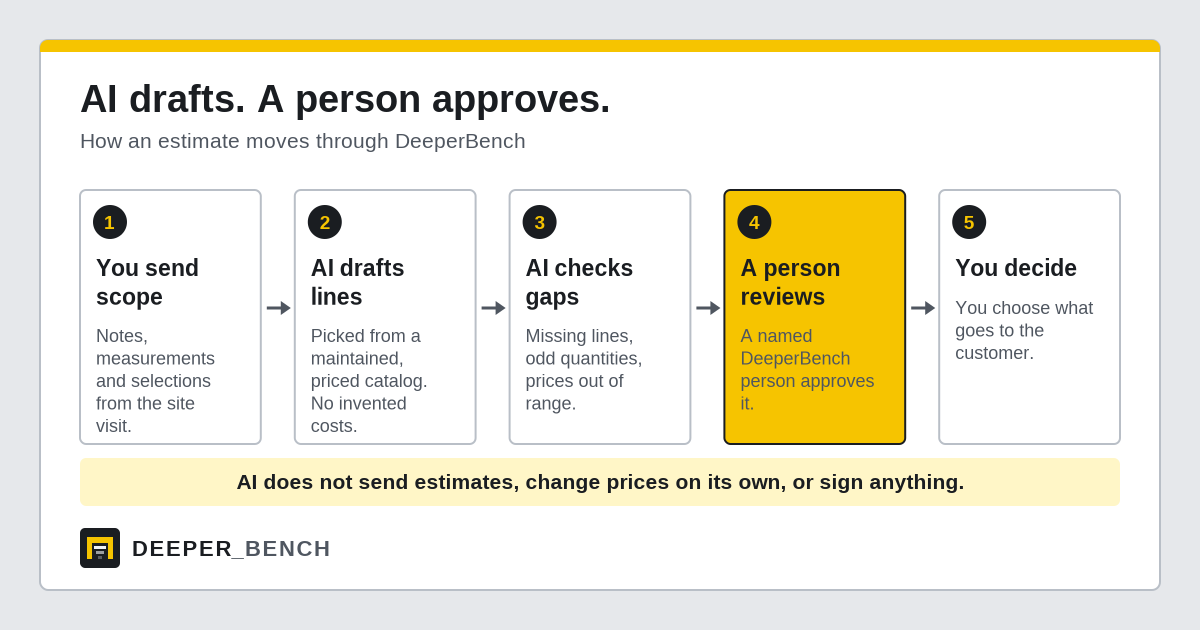
AI estimating for contractors uses software to draft or check estimates faster. At DeeperBench, AI helps build line-item estimates from a maintained priced catalog and reviews estimates and contracts for gaps. A named person approves the work before it reaches a customer. It is a service you use, not software you have to run.
What problem is AI estimating supposed to solve?
Estimates are slow, and the slowness costs jobs. A homeowner who is waiting a week for a number is getting other numbers. The other problem is inconsistency: the same bathroom priced three ways by three people, with something missing from each.
AI can help with both, but only if it works from your real prices and a person stays accountable. A general chatbot guessing at costs is a risk, not a shortcut.
What does AI do in our estimating?
Three jobs, all with a person checking the output.
- Drafting. From your scope notes, measurements and selections, AI helps assemble line items from our maintained, priced catalog. It picks from defined lines with units and prices. It does not invent costs.
- Estimate review. AI looks for what is missing or odd: no demolition and disposal line on a gut job, a quantity that does not fit the room, a price far outside the range for that line, allowances with no stated amount.
- Contract review. AI compares the contract or proposal text to the estimate and flags scope that was priced but not written, or written but not priced.
Who approves the work?
A named person at DeeperBench reviews every estimate before it goes back to you, and you decide what is sent to the customer. AI does the drafting and the first pass at checking. It does not send estimates, change prices on its own, or sign anything. That rule is the same across all of our back office work.
AI estimating software vs service: which should you choose?
| Question | Software you run | DeeperBench service |
|---|---|---|
| Who builds the price catalog? | You, usually | We maintain it |
| Who does the work? | Your owner or office staff | Our team drafts; you approve |
| Who checks the output? | You | A named person, then you |
| Setup effort | Training and data entry on your side | You send scope notes; we do the rest |
| Best fit | A firm with an estimator who wants a faster tool | An owner-led firm with no spare estimating hours |
If you already have a skilled estimator, software may be all you need. If estimates are waiting on the owner, a tool only adds one more thing to learn. A service removes the hours.
What does a catalog line look like?
A line is specific enough to price and plain enough for a homeowner to read. For example: "Remove and dispose of existing bathroom vanity and top, per unit," or "Install 36-inch tiled shower niche, each." Each has a unit, a unit price, and a cost basis behind it. The AI picks and combines these lines. It does not make up a number when a line is missing. It flags the gap to a person, who either adds a line to the catalog or prices that item by hand and notes it.
This is why the approach suits remodelers. Remodeling work repeats in pieces even when no two jobs match. Most of a kitchen estimate is lines you have priced before.
What does AI estimating not do here?
- It does not take off quantities from plans or drawings. We are not a takeoff service.
- It does not read a site. Your team still visits, measures and notes conditions.
- It does not guarantee a price. It produces a consistent draft from your catalog and your margin rules, and you own the final number.
- It does not make unsupervised decisions. Anything uncertain gets flagged to a person.
What do you keep?
You keep the site visit, the customer conversation, the decision on markup and the call on what to send. You also keep your crews and project management. The estimating service sits underneath, and connects to job costing so a job's estimate becomes its budget.
Who should skip it?
Firms bidding from plan sets, firms with a strong in-house estimator already running a catalog, and anyone who wants to hand over pricing judgment entirely. We do not recommend that last one for any provider. If you are unsure, read our in-house vs outsourced comparison.
What is a low-pressure next step?
Ask for a demo, bring a recent estimate, and watch how it would be built and reviewed. Details on the estimating service page, or contact us with questions.
Common questions
Is AI estimating accurate?
It is as accurate as the catalog and the scope notes behind it. AI drafts from priced lines and flags gaps, and a person checks the result. You still own the final price, so treat it as a consistent draft, not a guarantee.
Will AI send estimates to my customers?
No. A named person approves each estimate, and you decide what goes to the customer. AI never sends anything on its own.
What is the difference between AI estimating software and a service?
Software gives you a tool and leaves the work and the price data to you. A service does the drafting and keeps the catalog current, with a person approving. Which is better depends on whether you have the hours and the estimator.
Does it work from blueprints?
No. We do not do quantity takeoffs from plans. We price from site notes, measurements and selections your team provides.