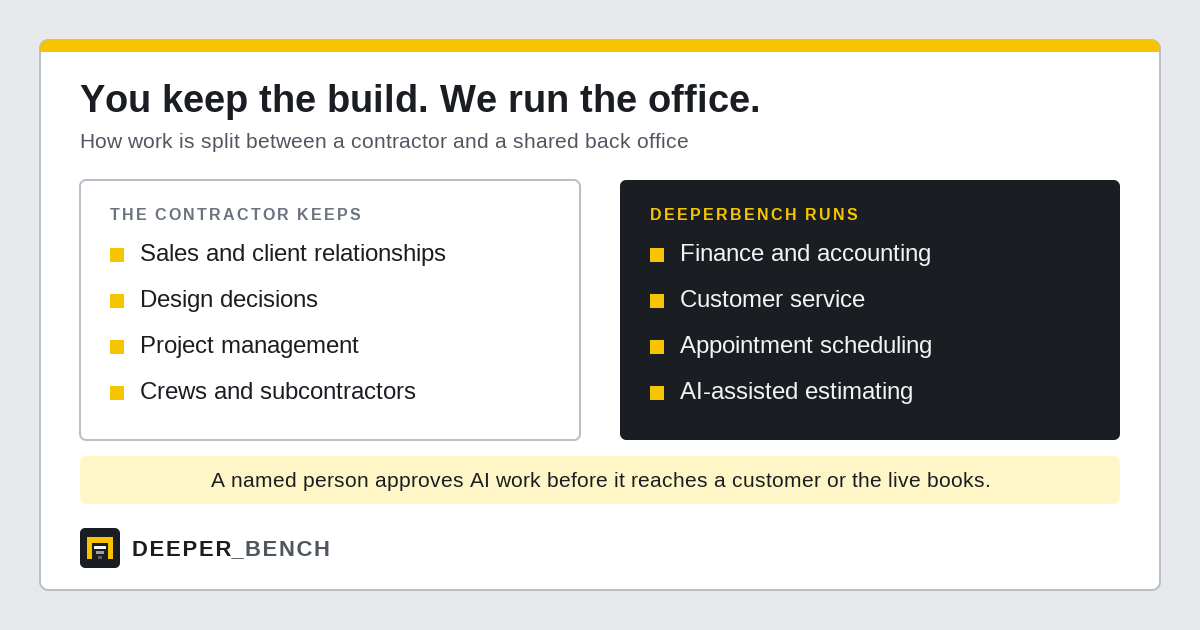
An outsourced back office for contractors is a service that takes over the office work behind the field work: bookkeeping and job costing, calls and scheduling, estimating support, marketing support and HR admin. The contractor keeps sales, design, project management and crews. A named person reviews the work before it reaches a customer or the books.
Why does the office fall behind when the company grows?
You sold more jobs, so the phone rings more, the estimates stack up, the receipts pile up and the books run three weeks late. Someone who should be selling or walking jobs is answering messages at 9 p.m. Nobody planned this. The office just never got a real owner.
This is the normal shape of a small contractor. More than 90% of construction payroll establishments have fewer than 20 employees (CPWR, from Census data), so most firms run the office on an owner, a spouse, one coordinator and a part-time bookkeeper. The margin for error is thin. The NAHB Remodelers' Cost of Doing Business Study (2026 edition, FY2024 data) puts operating expenses at 23.6% of revenue and net margin at 6.3%. By our own arithmetic, a 2-point leak from late invoices, missed change orders or unbilled work is about a third of that profit (2 divided by 6.3).
What is a contractor back office?
A contractor back office is everything that keeps a construction or remodeling company running but does not happen on the jobsite or in front of the customer. It is money in, money out, who answers, who is booked where, what a job should cost, and who is on payroll.
An outsourced back office for contractors hands that work to an outside team that runs it as a system, not as a pile of tasks. The key word is system. One set of records, one set of rules, one person accountable for each output. For a task-by-task list, see the contractor back office checklist.
What does DeeperBench run for you?
DeeperBench is a shared back office for owner-led contractors, roughly $2M to $20M in revenue. It runs on one system, so the books, calls, schedule and estimates share the same job records.
- Finance and bookkeeping: job costing, cash, monthly reporting, and fractional CFO guidance.
- Customer service and scheduling: calls, messages and estimate appointments, routed by travel time.
- AI-assisted estimating: drafts built from your priced catalog, checked by a person.
- Supporting marketing, project planning and HR admin.
AI does the drafting and routine work. A named person approves before anything reaches a customer or the live books. That is the rule, not an option.
What does DeeperBench not do?
We do not sell jobs, design, run your projects or supervise crews. We do not do tax preparation, audits, legal work, insurance or financing, and we are not a payroll or PEO provider. Your CPA and attorney stay your CPA and attorney. We work alongside them and hand them cleaner records.
What do you keep?
You keep the work that wins and delivers jobs: sales, design, project management and crews. You keep every decision with money or a customer promise attached: what to bid, what to discount, who to hire. You also keep decisions about your books and data, and your CPA keeps working from them.
How does it compare with an office manager, a VA, a CPA or software?
Each option solves part of the problem. The honest question is which parts you still need to cover yourself.
| Option | Strong at | Gaps to plan for |
|---|---|---|
| Office manager (in-house) | Knows your people and customers; on site; flexible | One person, one skill set. Vacation or turnover stops the office. Rarely a job-cost specialist |
| Virtual assistant | Inbox, calendar and data-entry help at low commitment | Usually no process ownership or review layer. Limited accounting depth. You manage the work |
| CPA firm | Tax, compliance, year-end statements, advice on structure | Typically periodic, not daily. Seldom answers phones, schedules or builds estimates |
| Point software | Does one job well: accounting, scheduling, estimating | You still need people to run each tool, and tools do not share records unless someone connects them |
| Shared back office | Several functions on one system, with a review step | Less hands-on than a person in your building. Needs clear handoffs from you |
Many firms combine these. A good shared back office works with your CPA, not instead of one, and many keep a part-time coordinator who handles what must happen in person. For the in-house comparison in detail, read office manager vs outsourced back office. For the assistant route, see virtual assistant vs back office service.
What does it look like in practice?
At Black River Design Build, a design-build remodeler and our case study, the platform runs daily and retired 4 software subscriptions, removing $30-40K a year of software spend (DeeperBench production data, 7 October 2026, unaudited). One firm is not a promise about yours. The results page has the case study.
How does the work get done and checked?
Routine work is drafted by AI: coding a bill to a job, drafting an estimate from your catalog, proposing an appointment slot, writing a customer reply. A named person reviews and approves before anything reaches a customer or the live books. If the system is unsure, it flags the item instead of guessing. You can see who approved what.
Who is this not for?
- Solo operators with a few jobs a year. A bookkeeper and a good phone plan are enough.
- Firms that want a person in the office every day, handling walk-ins and the front desk.
- Large contractors with an established finance department and controller.
- Owners who want a vendor to make bid, pricing or hiring decisions for them.
How do you start?
Start small. Look at how it works and what it costs on the pricing page. Then see a demo with your own problem in mind, or write to us and describe where the office is slipping. If we are not the right fit, we will say so.
Common questions
What is an outsourced back office for contractors?
It is an outside team that runs the office side of a construction or remodeling company: bookkeeping, job costing, calls, scheduling, estimating support and HR administration. The contractor keeps sales, design, project management and crews.
What back office tasks can a contractor outsource?
Bookkeeping, job cost reporting, invoicing and collections follow-up, call and message handling, appointment scheduling, estimate drafting, onboarding paperwork and basic HR records. Decisions on pricing, hiring and customer promises should stay with the owner.
Is outsourcing the back office the same as hiring a virtual assistant?
No. A virtual assistant is one person doing tasks you assign and manage. A back office service runs defined functions on shared systems, with review steps and coverage when one person is out.
Will I still need my CPA?
Yes. We do not do tax preparation or audits. A cleaner set of job-based books usually makes the CPA conversation faster, but confirm your own arrangement with your CPA.
How much does it cost?
See the pricing page for current plans. Cost depends on which functions you hand over.