Remodeling lead response is how quickly and consistently your company replies to a homeowner inquiry. DeeperBench answers calls, texts and web forms, asks your intake questions, books the estimate, and follows up on leads that go quiet, with a named person approving the AI-drafted messages.
Why do good leads go cold?
You paid for the lead, or earned it through a referral or a good review. Then it sat. The owner was on a job, the office person was out, the web form went to an inbox no one checks on weekends. By the time someone called back, the homeowner had talked to two other contractors.
The best-known research on this is from 2011 and covers web leads across all industries, not remodeling. In a Harvard Business Review study of 2,241 US companies, the average response took 42 hours, 23% never replied, and a lead contacted within an hour was nearly seven times as likely to qualify as one contacted later. That tells you the direction. It does not tell you your number. We say more in how fast contractors should respond to leads.
We are not aware of a reliable, contractor-specific figure, so we will not invent one.
What does DeeperBench do with a new lead?
This is DeeperBench's live customer service and scheduling service, not a tool in development.
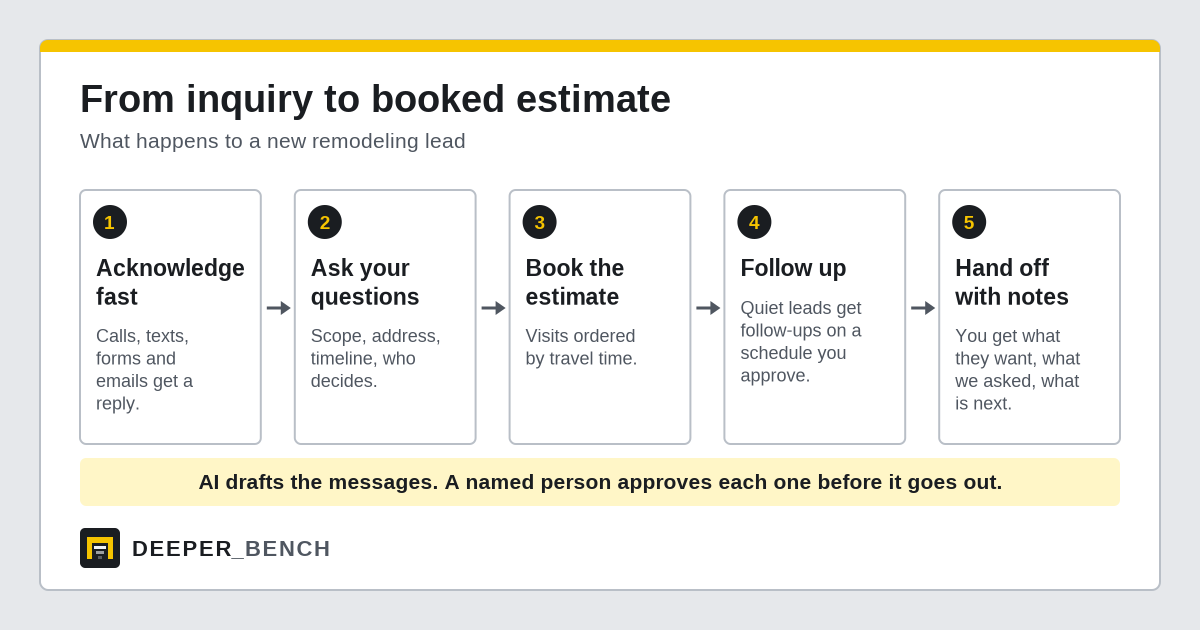
- Acknowledge fast. Calls, texts, web forms and emails get a response in your company name, with a clear next step.
- Ask your intake questions. Scope, address, home age, timeline, who decides, how they found you. See questions to qualify remodeling leads.
- Book the estimate. Qualified leads go onto your calendar, ordered by travel time. See appointment scheduling.
- Follow up. If a homeowner goes quiet after the first contact, we send follow-ups on a schedule you approve.
- Pass the lead to you with notes. You get a summary: what they want, what we asked, what we promised, what is next.
AI drafts the replies and the summaries. A named person reviews and approves each message before it goes out. Nothing is promised to a homeowner that you did not set up beforehand.
How does follow-up for leads that go quiet work?
Most follow-up fails because it is nobody's job. We make it a rule. A typical pattern, which you can change:
- Same-day reply to every new inquiry.
- A second attempt by a different channel, such as a text after a missed call.
- A short check-in a few days later with an easy yes or no.
- A polite close-out that leaves the door open.
Every message uses your tone and your wording. We stop the moment a homeowner says no or books.
What should you measure?
You do not need software to start. For one month, record for every inquiry the time it arrived, the time of the first real reply, and whether an estimate was booked. Then group them by how long you took. Most owners find a few leads that sat for days, and those are the cheapest wins.
When we run lead response, those same three data points are visible to you, so you can see the speed and the outcome without asking anyone.
What does DeeperBench not do?
- We do not buy leads, run ads or manage your lead sources. For marketing, see our marketing services.
- We do not sell the job, quote prices or negotiate. Your salesperson does.
- We do not guarantee a booking rate. A slow estimate or a weak close still loses jobs.
What do you keep?
Sales, design, project management and crews stay with you, along with the relationship and the final word on which leads you take. The records of every lead and every message stay in your account.
Who is this not for?
If you get a few leads a month and always call back within the hour, you do not need us. This is for owner-led firms where leads arrive faster than the owner can answer them, or where nobody owns follow-up. If your problem is lead quality rather than speed, fix the source first.
Case study, as secondary proof: at Black River Design Build, the platform has handled 27,683 messages (DeeperBench production data, 7 October 2026, unaudited).
What is the next step?
Count how many inquiries you got last month and how many got a reply within a day. Then book a demo and we will show how those leads would be handled. You can also contact us first. For how the work is set up end to end, see how it works.
Common questions
How fast will you respond to a new lead?
We set a response standard with you at onboarding, based on your hours and lead channels. We will not quote a universal number because it depends on the channel and the hours you want covered.
Do you contact homeowners who did not ask to be contacted?
No. We respond to inquiries sent to your company and follow up on those conversations. We do not cold-call purchased lists.
Will follow-up feel pushy?
Messages use your wording and cadence, and a person approves them. We stop when a homeowner says no or books.
Does faster response guarantee more jobs?
No. Research suggests speed helps leads qualify, but it is an old study of web leads across industries. Fast replies get you to the estimate. Winning the job is up to the estimate and your sales process.