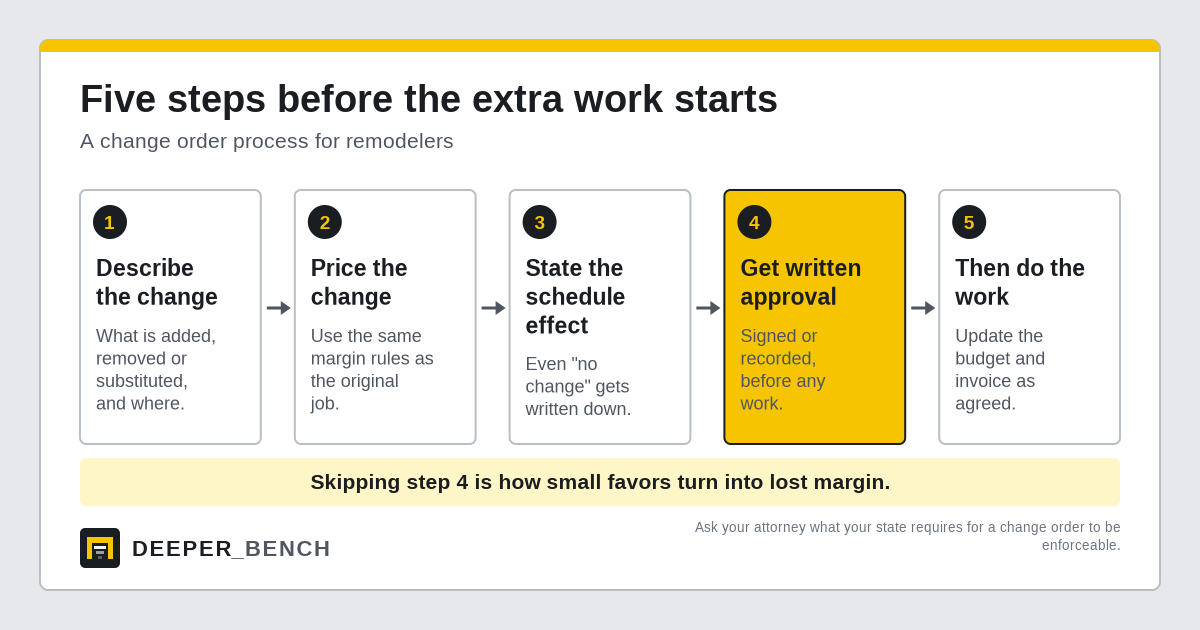
A change order process for remodelers has five steps: describe the change, price it with the same margin rules as the original job, state any schedule impact, get the customer's written approval, and only then do the work. Skipping step four is how small favors turn into lost margin.
What is a change order and why does it matter?
A change order is a written agreement to change the price, scope or schedule of work already under contract. It exists so that both sides agree on what changed and what it costs before the work happens.
In remodeling, changes are normal. Owners find something in the wall, pick a different faucet or decide the lights should move. The problem is not changes. It is changes that get done on a handshake and never billed.
How does a change order become a margin leak?
Each unbilled change looks small. Together they can erase the profit on a job.
Illustrative example, not a benchmark. A $100,000 remodel. At the NAHB 2026 study average of 6.3% net margin, that job nets about $6,300.
During the job the owner asks for 6 small changes. Each costs you $1,120 in direct cost (electrician $640, patch and paint labor $360, materials $120). 6 x 1,120 = $6,720 of direct cost.
Priced properly at a 30% gross margin, each change would be 1,120 / 0.70 = $1,600, or $9,600 for the six. If you do all six for free, you absorb $6,720. That is more than the whole $6,300 the job was meant to net. The result is a job that looks fine until the books close.
Our arithmetic, and it is simplified. But the shape is real: net margins are thin, so a small percentage of unbilled work does outsized damage.
What are the steps of a good change order process?
- Stop and name the change. Anyone on the crew who hears "can you just..." says "I will write that up" and does not start.
- Describe it in plain words. What is being added, removed or substituted, and where.
- Price it by the same rules as the contract. Direct cost plus your standard overhead and profit, not a guess. Include supervision time and any reordering of the schedule.
- State the schedule effect. Even "no change to completion date" should be written.
- Get written approval. A signature, or an electronic approval that records who agreed and when. Ask your attorney what your state requires for enforceability.
- Update the job budget. The approved change adjusts both contract value and cost budget, so the job report stays meaningful.
- Invoice it on the schedule you agreed.
What should a change order include?
- Job name and a sequential change order number.
- Date, requester and who approved.
- Scope description, with reference to the original line items it touches.
- Price added or deducted, itemized.
- Effect on the schedule.
- Revised contract total.
- Payment terms for the change.
What about changes that are urgent or small?
Emergency conditions happen, such as discovering a leak that must be stopped now. Your contract can say that urgent work needed to protect the property proceeds, with a change order issued right after. For small items, many firms set a threshold below which the project manager can approve by text, as long as it is logged. Whatever you choose, write the rule down and apply it every time. Contract language is a matter for your attorney.
Hidden conditions are a special case. Rot, bad wiring and surprises behind walls are where estimates get hurt most. Your estimate should say which unknown conditions are excluded and how they will be priced when found.
How do you keep change orders from slipping?
The failure is usually process, not intent. Common fixes:
- Put the change order form where the project manager and lead carpenter can reach it from the site.
- Give each job a short list of open changes reviewed weekly.
- Compare billed changes to cost codes. If cost shows up for work that was never invoiced, you have an unbilled change. Job costing is how you spot it.
- Review the handoff between sales and production, since many unrecorded changes begin as verbal promises in the sales stage. See our guide to the sales to production handoff.
What should you say when the customer asks for a change?
Most owners lose money on changes because the conversation feels awkward, not because they cannot do the math. A short script helps. Something like: "Happy to do that. Let me price it and send you a one-page change order. We will start once you approve it." That is friendly, specific and sets the rule without a lecture. Teach it to every project manager and lead carpenter so the answer is the same on every job.
Who should approve what?
| Type of change | Typical handling |
|---|---|
| Selection above an allowance | Change order for the difference, noted in the estimate terms |
| Added scope the owner requests | Priced change order, written approval before work |
| Hidden condition found | Stop, photograph, price, approve, then proceed |
| Deduct (owner removes scope) | Credit change order at cost plus whatever your contract says about margin |
| Urgent protection of the property | Proceed as your contract allows, document at once |
Your attorney should confirm how each fits your contract. The point is that every row has an agreed path.
Where does DeeperBench fit?
We price change orders from the same catalog as the original estimate, so the margin rules stay consistent. AI helps draft the description and checks the pricing; a named person approves before it goes to the customer, and you keep the project management and the customer conversation. The books side, such as adjusting job budgets, sits in our bookkeeping and fractional CFO service. If change orders are leaking margin, talk to us.
Common questions
Do I need a signed change order for small changes?
It is safest to document every change, even small ones. Many firms allow approval by text under a set dollar amount as long as it is logged. Check with your attorney about what your state treats as enforceable.
How should I price a change order?
Use the same method as the original job: direct cost plus your standard overhead and profit. Include extra supervision and any schedule disruption. Do not discount just because the change feels small.
What if the customer refuses to sign?
Do not start the work. Explain the cost and schedule effect, offer to proceed with the original scope, and keep the written record. If the change is needed for the work to be safe or code compliant, escalate to your attorney.
How do I track whether change orders are costing me money?
Compare cost posted to each job against billed work. Cost with no matching invoice usually signals unbilled changes. A weekly look at open changes per job catches most of it.