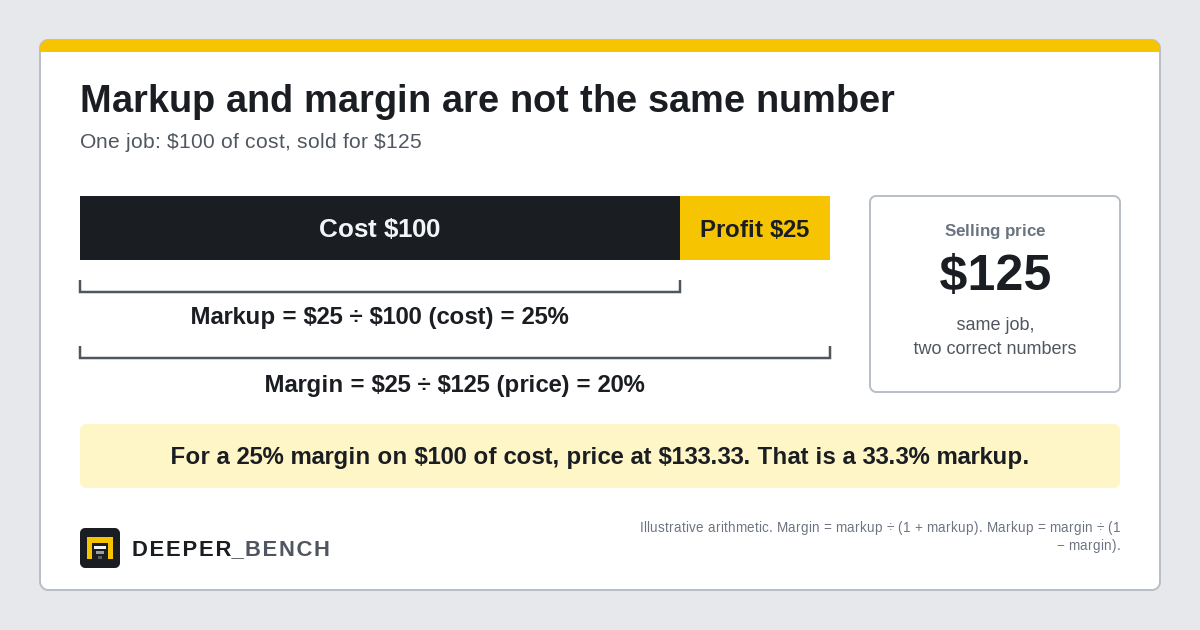
Markup is profit as a percentage of cost. Margin is profit as a percentage of the selling price. A 25% markup gives only a 20% margin. Contractors who add 25% to cost and expect a 25% margin collect less than they planned on every job.
What is the difference between markup and margin?
Both describe profit on a job. They use different denominators.
- Markup = (price - cost) / cost
- Margin = (price - cost) / price
Cost is always smaller than price, so markup is always a bigger number than margin for the same job. A job costing $100 and sold for $125 has a 25% markup and a 20% margin. Same job, two correct numbers.
Margin is the number that shows up in your financials. Gross margin, overhead as a percent of revenue and net margin are all measured against revenue. That is why most owners find it easier to price from margin, even if their crew or supplier talks in markup.
How do markup and margin convert?
Two formulas: margin = markup / (1 + markup), and markup = margin / (1 - margin). The table does the math for common cases.
| Markup on cost | Gross margin on price |
|---|---|
| 10% | 9.1% |
| 15% | 13.0% |
| 20% | 16.7% |
| 25% | 20.0% |
| 30% | 23.1% |
| 40% | 28.6% |
| 50% | 33.3% |
| 100% | 50.0% |
| Margin you want | Markup you need |
|---|---|
| 20% | 25.0% |
| 25% | 33.3% |
| 30% | 42.9% |
| 35% | 53.8% |
| 40% | 66.7% |
What does mixing them up cost on a real job?
Illustrative example (not real company data). A remodeler's direct job cost is $80,000. Overhead runs 16% of revenue. The owner wants a 25% gross margin.
Right way: price = cost / (1 - margin) = 80,000 / 0.75 = $106,667. Gross profit: $26,667 (25.0%). Overhead at 16%: $17,067. Net before tax: $9,600, or 9.0%.
Wrong way: the owner adds 25% markup: 80,000 x 1.25 = $100,000. Gross profit: $20,000 (20.0%). Overhead at 16%: $16,000. Net before tax: $4,000, or 4.0%.
Same job, same crew, same 25% in the owner's head. Net falls from 9.0% to 4.0%, a loss of $5,600 in profit on one job (9,600 minus 4,000).
Compare 4.0% to 9.0%. The NAHB Remodelers' Cost of Doing Business Study (2026 edition, fiscal 2024 data) put average net profit at 6.3%, so a firm in this trap sits well below that average while believing it priced for more. The 6.3% uses NAHB's own definitions, so treat it as a rough reference only.
How much does a discount really cost?
Discounts come off price, but your costs do not move. Take the right-way job above at $106,667 with $26,667 of gross profit. A 5% discount removes $5,333 and leaves a price of $101,333. Gross profit falls to $21,333. A 5% price cut took 20% of the gross profit (5,333 / 26,667). Discount slowly and know what you are trading.
How do you price a remodeling job from margin?
- Build the direct cost: labor, materials, subs, permits, dumpster, allowance for waste.
- Add a contingency if scope is uncertain, and say so in the estimate.
- Know your overhead rate from your own books.
- Set the gross margin target: overhead percentage plus the net profit you want. If overhead is 16% and you want 9% net, the target is 25%.
- Divide direct cost by (1 - target margin) to get the price.
- Check the result against what the market will bear before you send it.
This is the same arithmetic a margin calculator does. A spreadsheet cell with =cost/(1-margin) is the whole tool.
Which common pricing mistakes should you watch for?
- Applying one markup to every job when labor-heavy and material-heavy work carry different risk.
- Marking up materials and labor at the same rate without checking the effect on overhead recovery.
- Giving away change orders at cost. Our change order guide covers how that leaks margin.
- Quoting from last year's costs when supplier prices have moved.
Does the answer change by trade or job type?
The formulas do not change. The margins you can get do. A kitchen remodel with owner-supplied selections, a roofing replacement and a design-build addition carry different risk, different subcontractor share and different change-order exposure. Some firms set a floor margin by job type and let the estimator move above it when risk is high or the schedule is tight.
A few practical habits help:
- Write the target margin on the estimate cover sheet, so anyone reviewing it sees what the number is meant to be.
- Compare the target margin to the actual margin when the job closes. A gap of several points on several jobs means the estimates are missing cost somewhere.
- Review the lowest-margin 3 jobs each quarter and ask what they have in common: a certain sub, a certain job type, a certain estimator, or a certain kind of client.
- When a supplier raises prices mid-project, update the cost basis before you price the next change order.
Sales tax, licensing and lien rules vary by state, so confirm how they enter your price with your CPA or attorney. The margin arithmetic above sits on top of whatever your jurisdiction requires.
How do you explain this to a crew lead or supplier?
Keep one rule for the whole company: quotes and reports use margin. If a supplier or a foreman talks in markup, convert it on the spot with the table. A 40% markup sounds healthy until you see it is a 28.6% margin, and a 28.6% margin has to cover overhead of 16% and still leave profit. Put the conversion table on the estimator's wall or in the estimate template, so nobody has to do the math from memory.
Where does DeeperBench fit?
Pricing works when the cost behind it is real. DeeperBench runs AI-assisted estimating against a priced catalog, and its job-cost reports show estimated against actual margin per job. AI drafts, and a named estimator reviews each estimate before it goes to a customer. You keep sales and the final price. To see how it would work for your jobs, book a demo.
Common questions
What is a good profit margin for a remodeling contractor?
It depends on how you define costs. The NAHB 2026 remodeler study reports 6.3% average net profit on fiscal 2024 data. Gross margin targets are higher because overhead comes out of them. Work backward from your own overhead rate plus the net you want.
Is it better to price with markup or margin?
Margin is usually safer because it matches how your financial statements read. If you price from markup, use the conversion table so you know the margin you are getting.
How do I turn a 30% margin into a markup?
Divide the margin by one minus the margin. 0.30 / 0.70 = 0.4286, so a 30% margin requires a 42.9% markup on cost.
Should markup be applied to labor and materials equally?
Not necessarily. Risk, overhead burden and supplier terms differ. Track margin by job and by cost type for a few months, then decide whether one rate fits your work.