Your contractor overhead rate is your annual indirect costs divided by a base, usually revenue or direct job costs. Add up the costs you cannot charge to a single job, divide by the base, and express the result as a percentage. Then build that percentage into every estimate so overhead is paid for.
What counts as overhead for a contractor?
Overhead is any cost of running the company that you cannot trace to one job. Direct costs, such as crew labor, materials, subcontractors and permits for a specific project, go on the job. Everything else is overhead, sometimes called general and administrative cost (G&A).
Typical overhead for a remodeler or small GC: office rent, office and admin payroll, the owner's non-production pay, general liability and other business insurance, software, phones, marketing, accounting and legal fees, shop and vehicle costs not assigned to jobs, and licenses. The line between direct and indirect is a policy choice. Pick one and apply it the same way every month. Your chart of accounts is where that choice gets recorded.
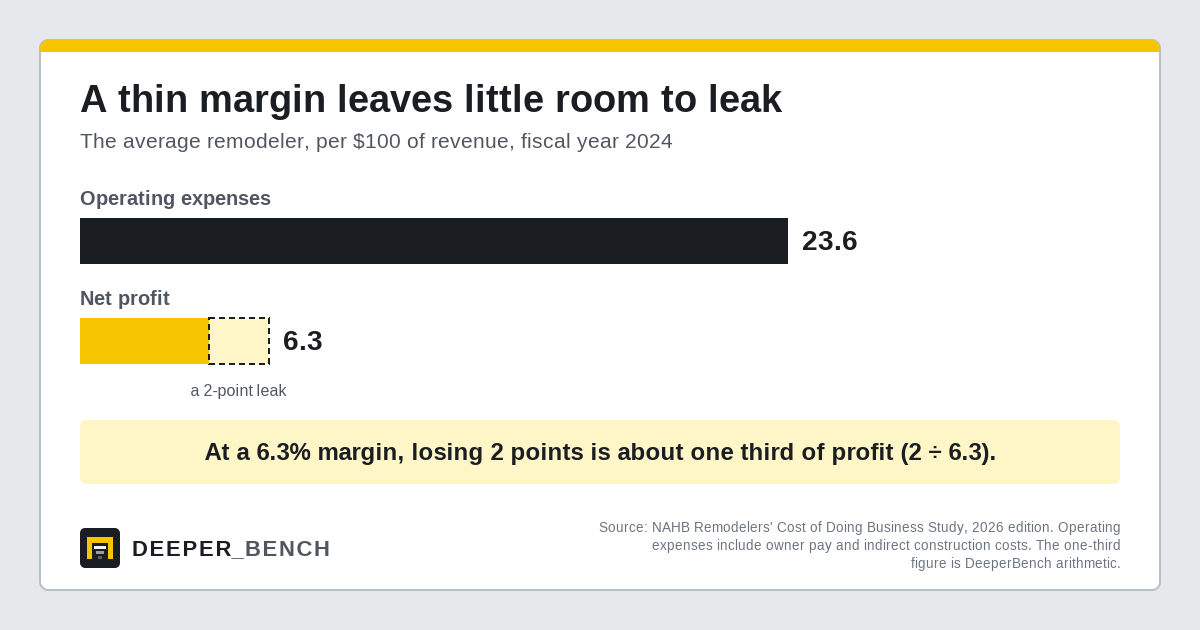
For context, the NAHB Remodelers' Cost of Doing Business Study (2026 edition, fiscal 2024 data) reports operating expenses at 23.6% of revenue and net profit at 6.3%. NAHB's operating expenses include owner pay and indirect construction costs, so do not compare its figure to yours until your definitions match.
How do you calculate the overhead rate?
- Pull 12 months of actual expenses from your books, not a budget.
- Sort each expense as direct (job cost) or overhead. Move anything miscoded.
- Total the overhead. Remove one-time items such as a lawsuit settlement or a vehicle sale loss, and note that you did.
- Choose a base: total revenue, or total direct job costs.
- Divide overhead by the base and multiply by 100.
- Repeat with the last 3 months to see if the rate is drifting.
The formula: overhead rate = annual overhead costs / annual base.
Illustrative example (not real company data). A remodeler has revenue of $2,400,000 and direct job costs of $1,800,000 (labor, materials, subs). Overhead for the year:
- Office rent: $36,000
- Office and admin payroll: $120,000
- Owner non-production pay: $90,000
- Insurance: $24,000
- Software: $18,000
- Non-job vehicle costs: $12,000
- Marketing: $72,000
- Accounting and legal: $14,000
Total overhead: $386,000. As a percent of revenue: 386,000 / 2,400,000 = 16.1%. As a percent of direct costs: 386,000 / 1,800,000 = 21.4%. Gross profit is 2,400,000 minus 1,800,000 = $600,000 (25.0%), so net profit before tax is 600,000 minus 386,000 = $214,000, or 8.9% of revenue.
Should you base it on revenue or on direct costs?
Both are correct. They answer different questions, so know which one you are using.
| Base | Example rate | Best used for |
|---|---|---|
| Percent of revenue | 16.1% | Comparing to other firms, tracking trend, setting the gross margin you need |
| Percent of direct job costs | 21.4% | Adding overhead to a cost-based estimate line by line |
The common mistake is mixing them. A 16.1% overhead rate applied to cost recovers less than the business spends. The same company needs 21.4% on cost to recover $386,000 from $1,800,000 of direct costs.
How do you build overhead into a price?
Take the job's direct cost, add overhead at your cost-based rate, then add profit. Profit is best set as a margin on the final price. The markup versus margin article covers why.
Illustrative job. Direct cost: $50,000. Overhead at 21.4% of direct cost: $10,700. Total cost: $60,700. Target profit: 10% of price. Price = 60,700 / (1 - 0.10) = $67,444. Check: 10% of 67,444 is 6,744, and 60,700 + 6,744 = 67,444.
If you had priced that job at direct cost plus 20% ($60,000), you would have collected $60,000 against $60,700 of total cost. That is a loss of $700 on a job that looked like a 20% markup.
How often should you recalculate it?
Quarterly is enough for most firms under $20M. Recalculate sooner if you add an office hire, move space, change insurance carriers or lose a large share of revenue. Overhead is mostly fixed in the short run, so a slow quarter pushes the percentage up even when spending did not change. If revenue drops 20% and overhead holds at $386,000, the rate on revenue rises from 16.1% to 20.1% (386,000 / 1,920,000).
What mistakes make the rate wrong?
- Leaving owner pay out, then wondering why profit disappears when the owner draws a salary.
- Counting a project manager's salary as overhead on some jobs and as job cost on others.
- Using a budget instead of actuals. Budgets tend to be optimistic.
- Letting books run months behind, so the rate is calculated from stale numbers.
- Forgetting that estimating, scheduling and customer-service labor is overhead until you decide to charge it to jobs.
What can you do with the number once you have it?
An overhead rate is a diagnostic as much as a pricing input. Three uses are worth the effort.
- Set a break-even revenue. If overhead is $386,000 and your gross margin runs 25%, you need 386,000 / 0.25 = $1,544,000 of revenue just to cover overhead. Everything above that is profit. The example firm at $2,400,000 clears that line by $856,000.
- Test a hire or a purchase. A new $60,000 office hire raises overhead to $446,000. At the same 25% gross margin, break-even moves to $1,784,000. The hire has to earn its way past that.
- Watch the trend. A rate that climbs for three quarters while revenue is flat is a spending problem. A rate that jumps in one quarter and falls back is usually a seasonal or one-time effect.
The arithmetic is simple: 446,000 / 0.25 = 1,784,000, and 1,784,000 - 1,544,000 = $240,000 of extra revenue needed to pay for a $60,000 hire at a 25% gross margin. That is a useful number to have before you post the job.
Where does DeeperBench fit?
The rate is only as good as the books behind it. DeeperBench runs bookkeeping and fractional CFO work for owner-led contractors: coding expenses to jobs or overhead consistently, closing the month, and producing the overhead figure from actuals. AI drafts the coding and a named person approves it before anything posts to the live books. You keep your pricing decisions. If you want to see what your own numbers say, get in touch. For tax treatment of any cost, confirm with your CPA.
Common questions
What is a normal overhead percentage for a contractor?
There is no single normal number, because firms define overhead differently. NAHB's 2026 remodeler study reports operating expenses at 23.6% of revenue, but that includes owner pay and indirect construction costs. Calculate your own from actuals using one consistent definition.
Is overhead the same as markup?
No. Overhead is a cost you must recover. Markup is the percentage you add to cost to reach a price, and it should cover overhead and profit. Treat them as separate steps.
Does owner pay count as overhead?
If the owner does non-production work such as managing the office or selling, a market-rate share of that pay belongs in overhead. Pay for work the owner does on a job can be a direct cost. Ask your CPA how to treat it for tax.
How do I lower my overhead rate?
You can cut indirect cost, grow revenue on the same overhead, or both. Start by reviewing software, insurance, and admin hours. Growing revenue without adding overhead lowers the percentage, but only if jobs are priced to hold margin.