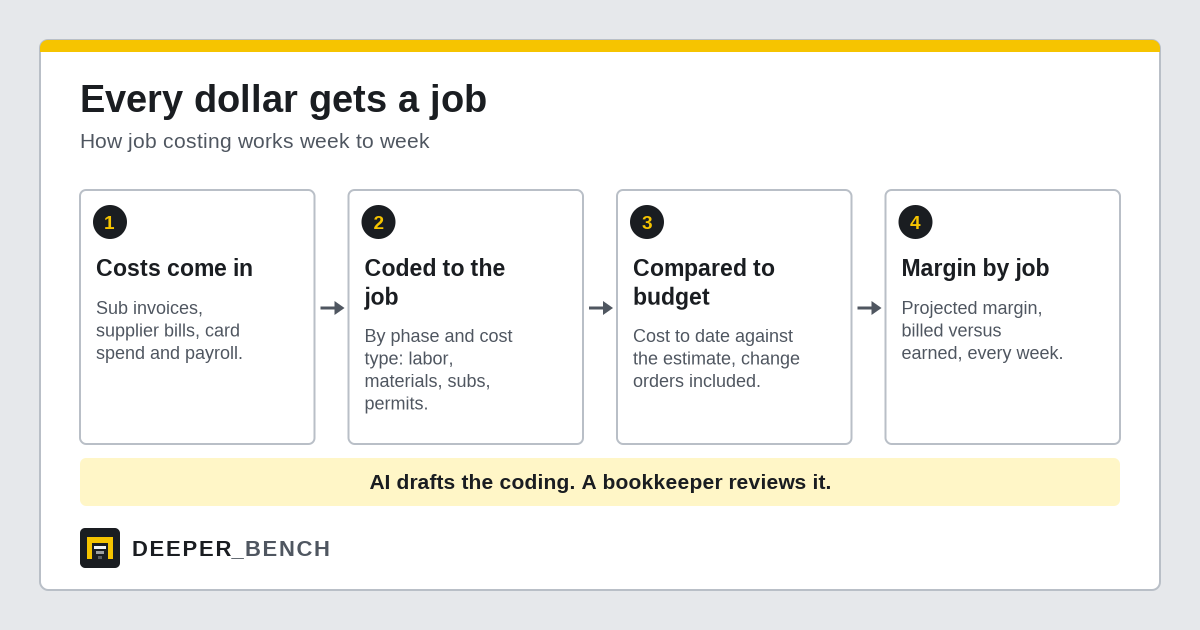
Job costing for contractors means assigning every labor, material and subcontractor dollar to a specific job and comparing it with the budget. DeeperBench does this weekly, tracks change orders, and reports projected margin by job. AI drafts the coding and a named person reviews it. You keep the field decisions.
Why do contractors lose money on jobs they thought were profitable?
Usually because nobody saw the job's real cost until it was over. Labor hours were estimated, not tracked. A sub's change order never made it into the budget. Materials bought for one job got coded to another. By the time the final numbers appear, the next three jobs are priced off the same bad assumptions.
The NAHB Remodelers' Cost of Doing Business Study reports a 6.3% average net margin for 2024. That is our arithmetic, not NAHB's, but it shows the stakes: a job that slips by 2 points of margin gives up about a third of that profit (2 divided by 6.3).
What does our job costing service include?
- A job structure that fits how you sell. Jobs, phases and cost types (labor, materials, subs, permits, equipment, other) set up once, so every dollar has a home.
- Budget loaded from your estimate. Where we also support your estimating, the budget comes from the priced estimate. Otherwise we load it from yours.
- Weekly cost coding. Sub invoices, supplier bills, card spend and payroll allocated to jobs. AI drafts, a bookkeeper reviews.
- Change orders tracked. Approved changes adjust the contract value and budget. Unapproved work is flagged so it does not turn into free work.
- Budget vs actual by job. Cost to date, estimated cost to finish, projected margin, and billed vs earned. See our guide to WIP reports for how the pieces fit.
- Job profitability reporting. A monthly view of which jobs, job types and business lines made money after direct costs.
What does that look like on one job?
Illustrative example. A $120,000 kitchen remodel is budgeted at $84,000 in direct cost, a 30% gross margin (36,000 of 120,000). Six weeks in, cost to date is $52,000. The project manager thinks the job is about 55% done, which implies $46,200 of cost. That is $5,800 over where it should be. With the weekly report, the owner sees that gap while cabinets are still being installed and can ask why. Without it, the extra spend shows up at final invoice and the margin is whatever is left.
The report does not fix the problem. It makes it visible early enough that you can talk to the sub, change the schedule or write a change order.
What do you need to give us?
Job costing is only as good as the inputs. Three things matter most:
- A budget for each job, even a rough one, broken out by cost type.
- A quick note from the project manager when scope, subs or approvals change.
- Time records by job, or an agreed way to allocate payroll when crews do not log hours.
If any of these is missing, we say so in the report instead of filling the gap with a guess. A projected margin built on a stale budget is worse than none.
What do you still do?
You and your project managers still run the jobs and decide percent complete in the field. We need your PMs to tell us when scope changes, when a sub is added and what is approved with the customer. We do not replace field judgment with software guesses. AI helps match invoices to jobs and flags unusual cost. A person reviews every entry before it hits the live books.
What do we not do?
- No field time-tracking app. We use the time and payroll data you already have, and we will tell you when it is too thin to trust.
- No tax or audit work, and no accountant's opinion on a lender or surety statement.
- No project management. If you want help with schedules and process, that is a separate service: project planning and management consulting.
Is it right for your company?
It works best when you have at least a handful of active jobs and you are willing to give us timely information. If you have one or two jobs at a time, a simple spreadsheet and good bookkeeping may be enough. Start with construction bookkeeping and add job costing when it pays for itself.
Job costing is part of our finance and bookkeeping service. To see what a month looks like, book a demo or send a note. We will say honestly if your volume does not justify it yet.
Common questions
Do I need job costing if I only run a few jobs at a time?
Not always. With one or two jobs, a good spreadsheet and clean books may be enough. Job costing earns its keep when jobs overlap and no one can hold every budget in their head.
Where do labor costs come from?
From your payroll provider and whatever time records you keep. If crews do not track time by job, we can allocate based on a method you agree to, but the numbers will be less precise. We will say so in the reports.
Can you use my existing estimates as the budget?
Yes. Budgets can be loaded from your estimating software or spreadsheets. If you also use our estimating service, the budget comes straight from the priced estimate.
Is this the same as a WIP report?
They are related. Job costing tracks cost against budget. A WIP report adds billings and percent complete to show whether each job is over or under billed. We produce both from the same data.